15 Types of Birds That Call the Beach Home

Monday brief

15 Types of Birds That Call the Beach Home

While people head to the shoreline to relax, many bird species migrate to, live by, and depend on coastlines, bays and tidal flats for feeding, resting or nesting. Here are fifteen bird types commonly found along beaches and other coastal habitats.

B

Benjamin Campbell

Desk note

Brief tip

The full sticky-note brief continues below on the Monday desk.

Board

Desk Notes

While people head to the shoreline to relax, many bird species migrate to, live by, and depend on coastlines, bays and tidal flats for feeding, resting or nesting. Here are fifteen bird types commonly found along beaches and other coastal habitats.

Seagull

Seagulls are familiar seaside birds with white and grey plumage and dark markings on their wings and head. They live along ocean coasts, large lakes and even Antarctica, nesting in sea-cliffs and dunes. They’re known for their scavenging behaviour and often appear around human activity.

Pelican

These large aquatic birds have long bills and extendable throat pouches. They inhabit tropical and temperate coastal regions (and some inland waters), though typically not the open ocean. Their webbed feet make them strong swimmers; their fishing technique is distinctive.

Avocet

Avocets are wading birds with long legs and upturned bills. They feature contrasting white and black plumage and forage in estuaries and salt-ponds, often along the coast. Look for them wintering along wetlands and seashores.

Tern

Terns are slender seabirds related to gulls, with forked tails and narrow wings. They nest on beaches, rocky islands or salt marshes, and feed over open water. Many species have worldwide distribution.

Jacana

Known as “Jesus birds” for their ability to walk on floating vegetation, jacanas have very long toes and feet that spread their weight. While more common in marshes and lagoons than exposed beaches, they are interesting coastal-wetland birds. They feature unusual parental roles, with females often dominant.

Sandpiper

Sandpipers are shore birds with narrow wings and long legs. They probe mud or sand for food and are found along beaches especially in the non-breeding season. Their subtle plumage blends into coastal mudflats and shorelines.

Oystercatcher

These chunky waders have long orange bills perfect for opening mollusks. They favour intertidal shores and adjacent beaches, and are found on most continents (except Antarctica). They often congregate where food is plentiful in tidal zones.

Plover

Plovers are mid-sized shore birds, usually with short bills and a hunting style based on sight rather than probing. You’ll find many plover species on sandy beaches worldwide. Many are migratory, using coastal zones to refuel.

Stilt

Stilts are long-legged shorebirds with very thin bills and typically pied (black and white) plumage. They inhabit shallow lagoons, salt marshes and coastal wetlands, including near beaches. Their long legs help them wade in shallow water to feed.
Albatross Albatrosses are large seabirds found largely over the open oceans of the Southern and North Pacific. While less typical on sandy beaches, they are important coastal/sea-edge birds and present in beaches near colonies. They have the greatest wingspan of any living bird.

Heron

Herons are long-necked, long-legged birds often seen standing at the water’s edge, waiting for prey. They inhabit both freshwater and coastal zones, including beaches. They don’t swim, but rather hunt from the shore or shallow water.

Flamingo

Flamingos are striking wading birds with pink-coloured plumage and long legs and necks. They feed in shallow lagoons, tidal flats, and coastal wetlands—places often adjacent to beaches. Their colour comes from the food they eat (mainly algae and crustaceans).

Ibis

Ibises are long-legged waders with curved bills. Many species live in coastal marshes and wetlands, sometimes right by sandy shores and estuaries. They vary widely in colour and form across regions.

Skimmer

Skimmers are a small group of seabirds whose lower mandible is longer than the upper—allowing them to skim food from the surface of water as they fly. They inhabit sandy beaches and islands. Their unusual feeding method stands out among shorebirds.

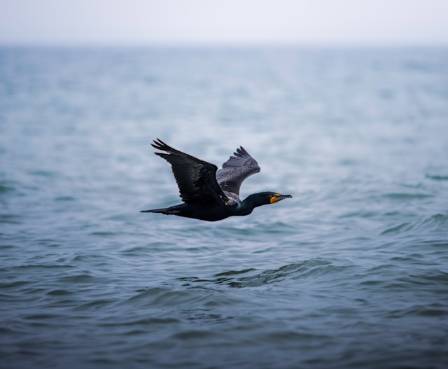
Cormorant

Cormorants are aquatic birds with hooked bills, webbed feet, and long wings. They live in many aquatic habitats—coastal bays, rocky coasts, mangroves and near beaches. They’re expert divers, often seen drying their wings on rocks after a hunt.

Why Beach Birds Are Important

Beach-birds often depend on the interface between land and sea—tidal flats, dunes, shallow water and estuaries—for feeding, nesting or refuge. Because these habitats are dynamic and vulnerable to human activity and climate change, observing and understanding beach-birds helps us gauge ecosystem health and conservation needs.

Final Thought

Next time you visit a beach, beyond sunbathing and swimming, take a moment to look down the shoreline and into the shallows. You might spot a sandpiper probing tidal mud, a tern diving for fish, or a flamingo standing in pink-toned water. Each of these fifteen bird types plays a unique role in the coastal world—and each is part of the rich biodiversity that makes beaches more than just sand and surf.

More from this board

NT

NOTE · en

A Journey Beyond Earth: The Evolution of Space Exploration

A Journey Beyond Earth: The Evolution of Space Exploration

Since ancient times, humans have gazed at the stars, filled with wonder about what lies beyond our world. This fascination eventually led to technological advancements that allowed us to break free from Earth’s gravity and begin exploring outer space.

NT

NOTE · en

Choosing Your Earring Style to Fit the Occasion

Choosing Your Earring Style to Fit the Occasion

The right pair of earrings can enhance your natural features while completing your overall appearance. Choosing earrings is not only about finding a design you love; it is also about selecting a style that works well with your face shape, outfit, and the impression you want to create. A beautiful pair of earrings may catch your attention because of its trendiness or unique design, but the best choice is one that highlights your strengths and complements your personal style.

NT

NOTE · en

Beautiful East Coast Beach Towns

Beautiful East Coast Beach Towns

When I take a beach vacation, one of my favorite things to do is explore the small towns scattered along the coastline near where I am staying. The beach may be the main reason for the trip, but these charming communities often become just as memorable, offering distinctive local traditions, historic character, and experiences that appeal to travelers of all ages.

NT

NOTE · en

How To Create A Cozy Reading Nook

How To Create A Cozy Reading Nook

Designing a cozy reading nook is a wonderful way to create a peaceful corner where you can relax, recharge, and get lost in a good book. Whether you read every day or simply want a quiet retreat in your home, the right setup can turn any small space into a comfortable escape.

NT

NOTE · en

Famous Abstract Sculpture

Famous Abstract Sculpture

Abstract sculpture has revolutionized the way we interpret form, space, and emotion. Unlike traditional representational art, these creations are not confined to literal depictions — they convey motion, balance, and energy through pure shape and material.

NT

NOTE · en

Cat Facts for Kids

Cat Facts for Kids

Cats, also known as domestic cats, are small meat-eating animals that have lived with humans for thousands of years. Their scientific name is Felis catus, and they are part of the feline family, which also includes lions, tigers, and leopards.